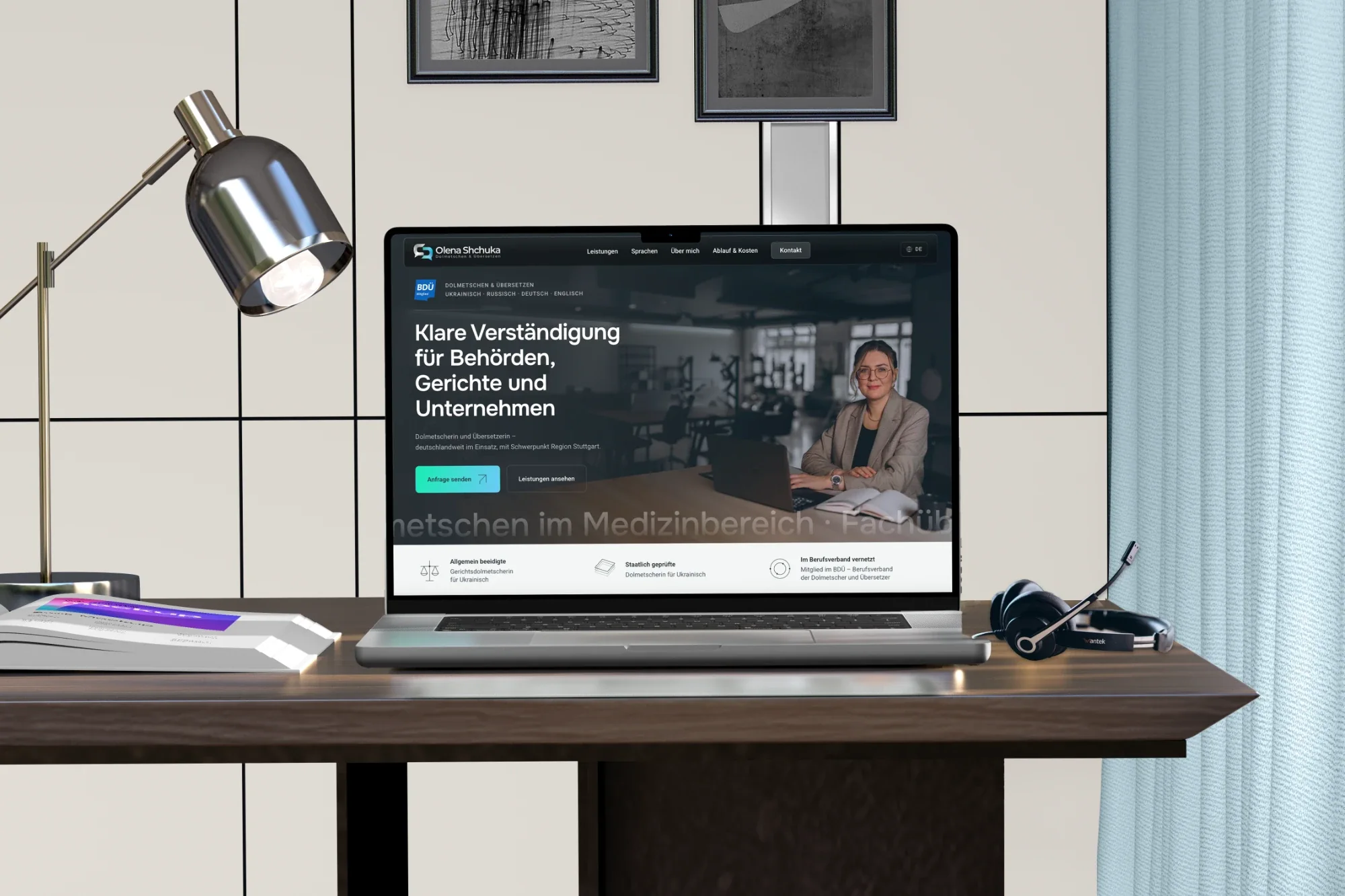
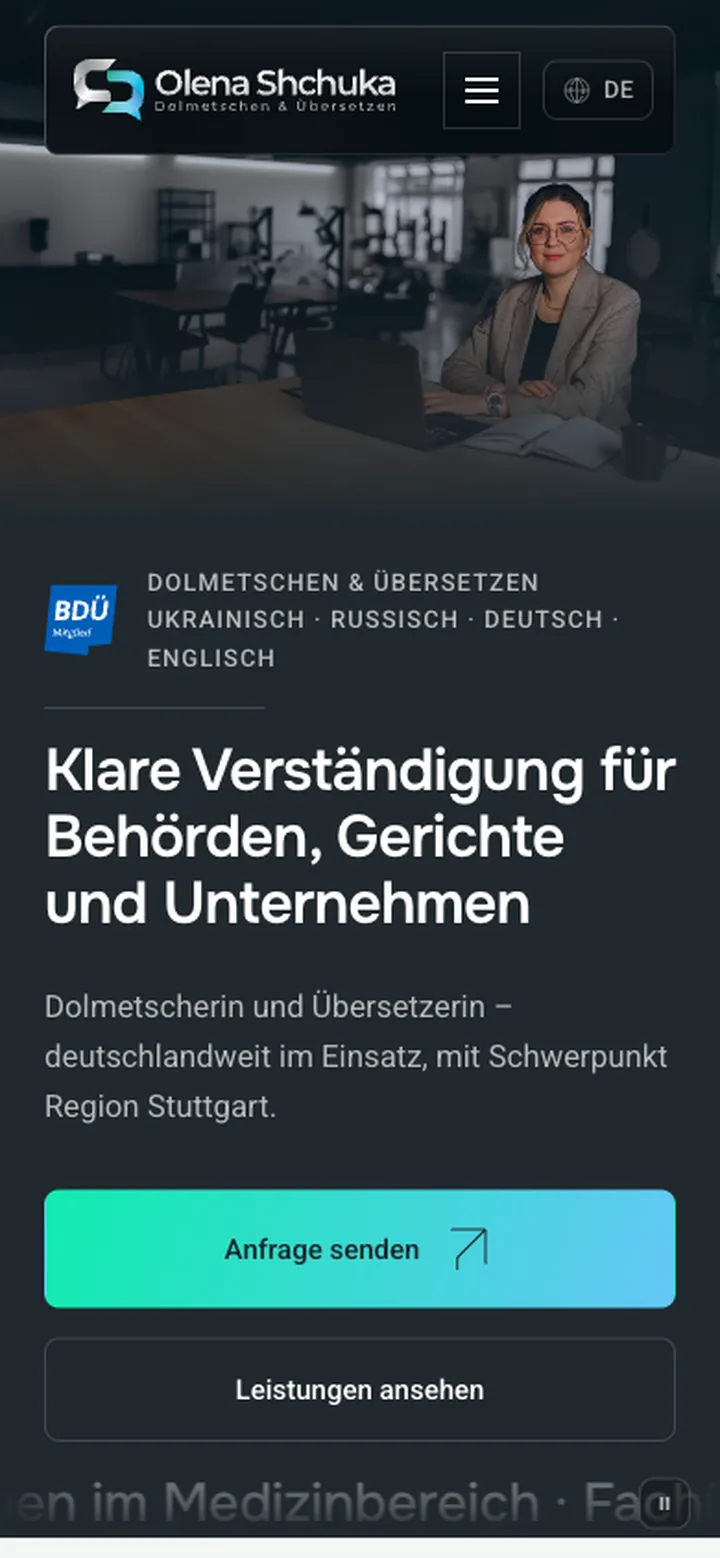
What makes a good website for interpreters and translators? For Olena Shchuka, a sworn court interpreter for Ukrainian based in the Stuttgart region, we built a four-language WordPress website – together with a logo, visual identity, photo shoot, business cards and Google setup. In this article I show how the project came together.
The project at a glance
- Client: Olena Shchuka, interpreter and translator, working across Germany with a focus on the Stuttgart region
- Website languages: German, English, Ukrainian, Russian
- Format: one-page website on WordPress
- What Jul Design delivered: logo and visual identity, structure and web design, WordPress build, photo shoot concept, business cards
- Visibility and legal: basic SEO, Google Search Console, Google Analytics, Google Business Profile with a Google Maps listing, legal notice (Impressum), privacy policy and cookie banner
- Website: olena-shchuka.de
The starting point
Olena and I had never met before. She found me through my ads in August and September. In our first phone call she told me about her work and what kind of website she needed.
Olena interprets and translates Ukrainian, Russian, German and English – for authorities, courts, notaries, companies, medical institutions and private clients. She is a state-certified interpreter for Ukrainian, sworn in at the Stuttgart Regional Court, and a member of the BDÜ, the German Federal Association of Interpreters and Translators. She studied translation in Ukraine as well as German and English studies at the University of Cologne.
What a website for sworn interpreters needs to do
People looking for an interpreter or translator need confidence quickly: Which languages? Which qualifications? For which situations? Authorities, courts and companies in particular look for proof. So the project focused on three goals:
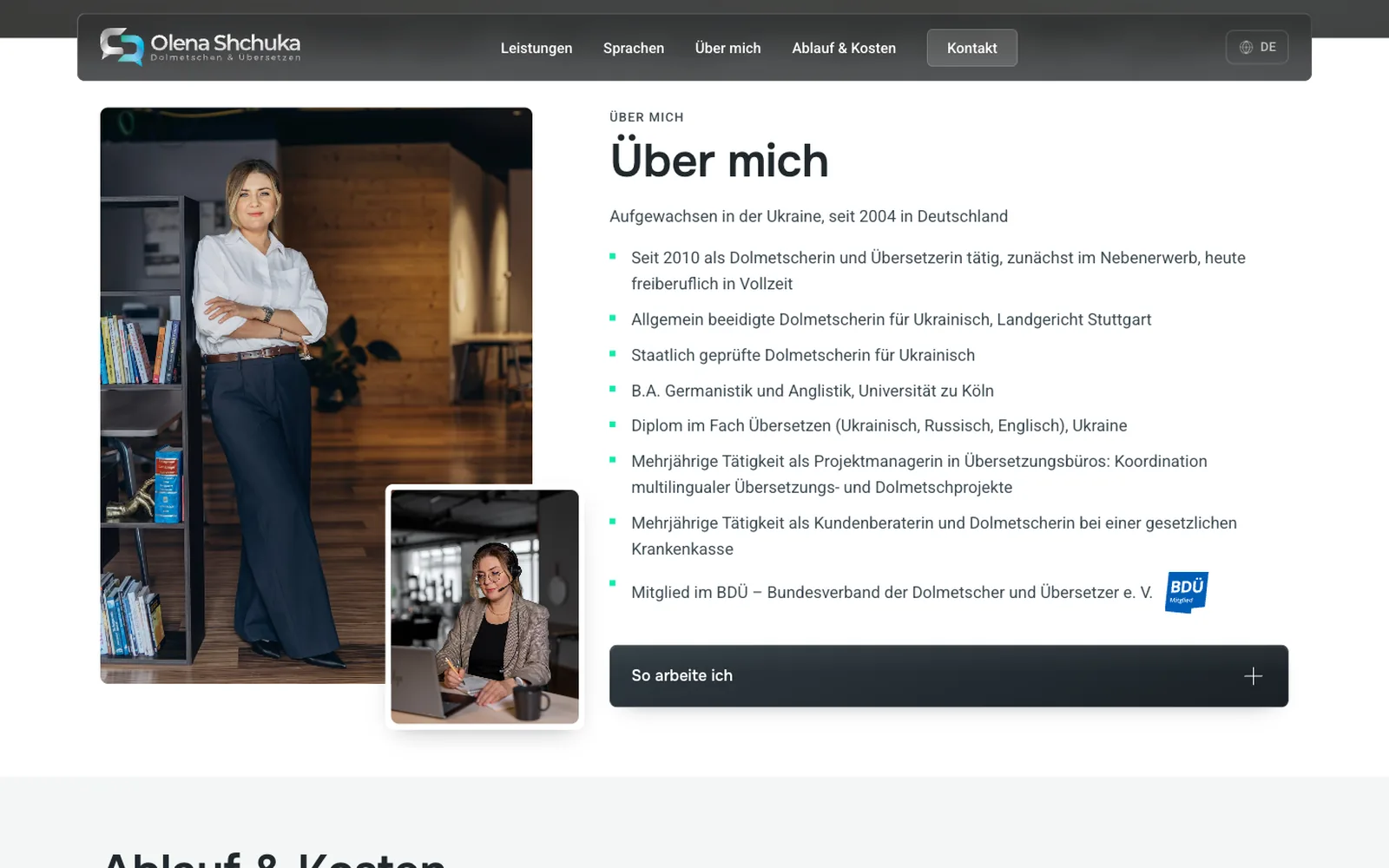
- Make qualifications visible: the sworn status, state certification and BDÜ membership sit right below the hero.
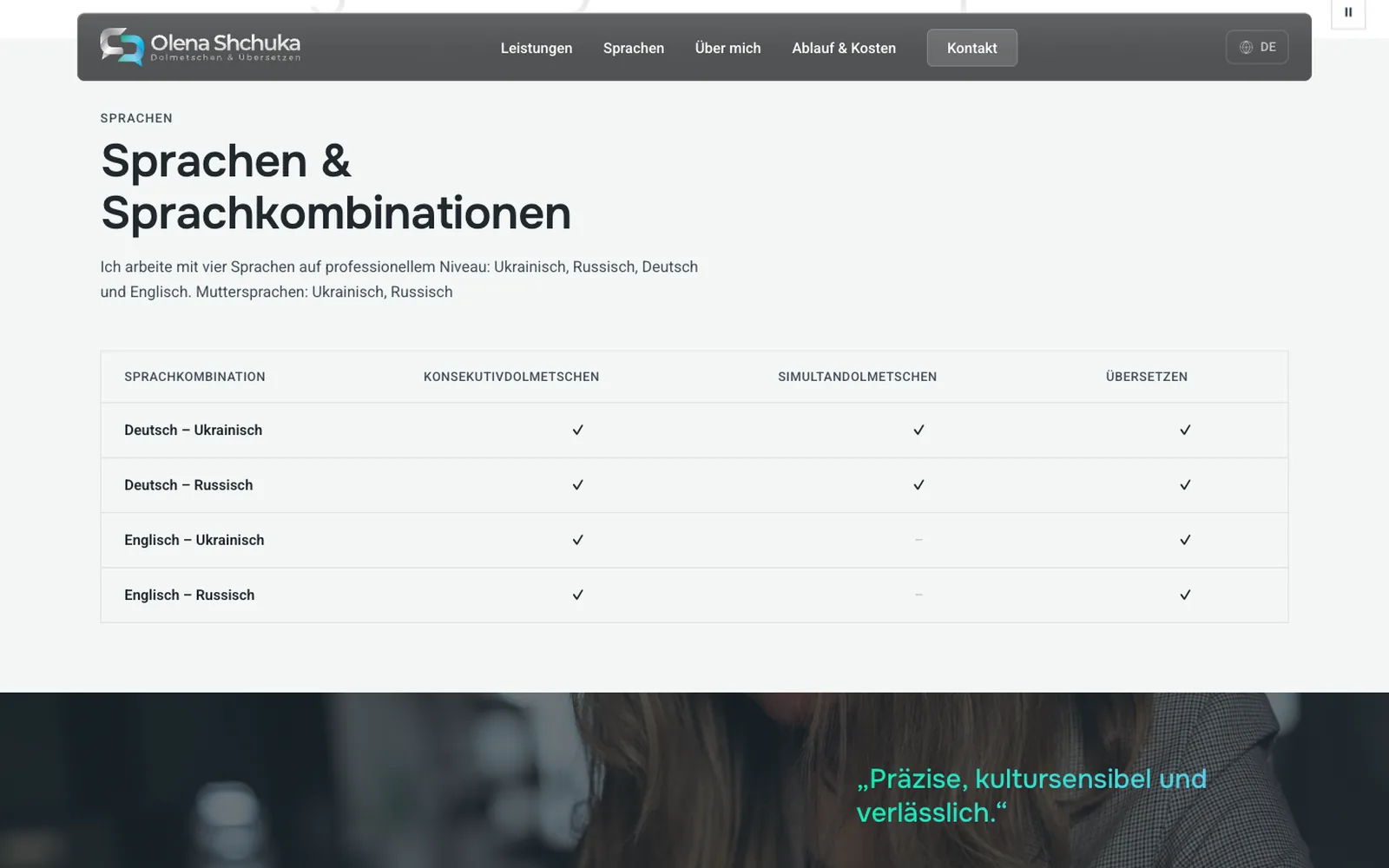
- Show language combinations clearly: a table shows at a glance which language pairs are available for consecutive interpreting, simultaneous interpreting and translation.
- Make enquiring easy: a clear process and a contact form that asks for what is needed for a quote.
One page, four languages – and a lot of content
The brief was a one-page website in four languages. The challenge: there is a lot of information. Services, settings, language pairs and qualifications had to be organised so that visitors find what they need quickly – without wading through a wall of text.
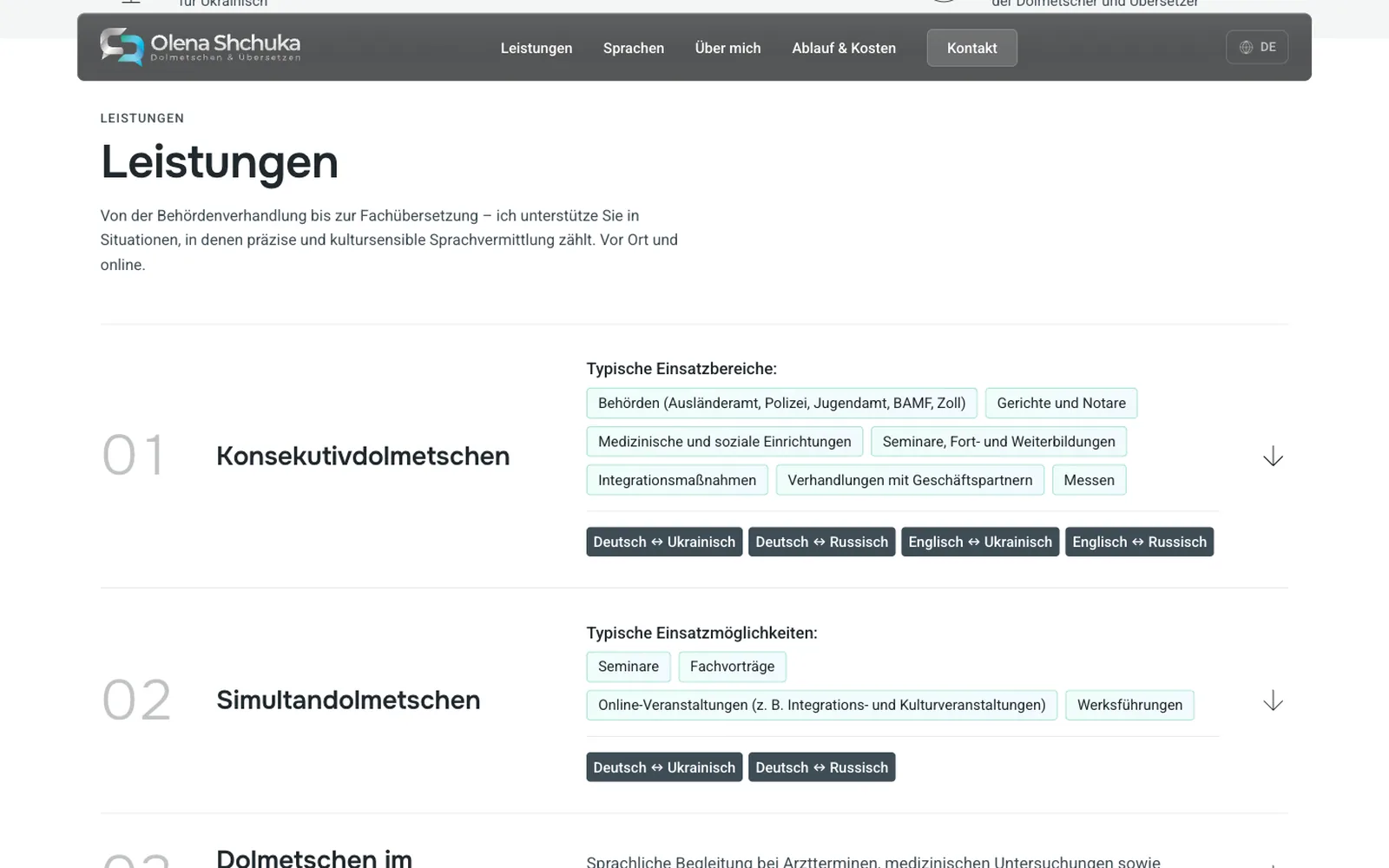
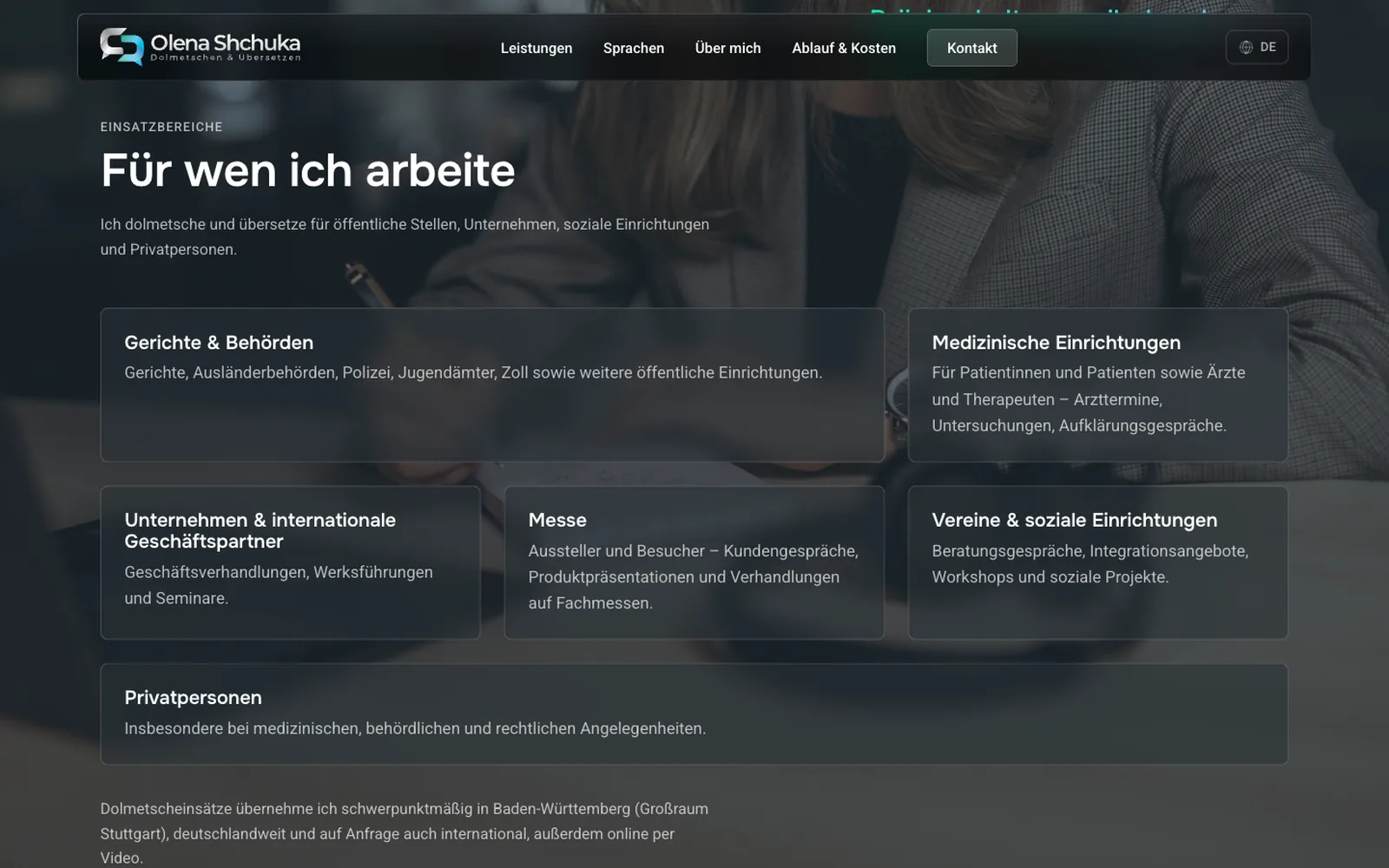
The solution: services are built as expandable blocks, with typical settings and language pairs as short tags. They are followed by the target groups, “About me”, “Process & pricing” and the contact section.
A first: web design entirely in Claude instead of Figma
This was the first website design I developed entirely in Claude – with skills, reference websites and a clear direction. The design work itself stayed the same: finding a direction, comparing, testing and refining details. Only the tool was new.
The big advantage: I could try changes directly in the design and see the result immediately. That also made it quick to agree the design with Olena. I will keep using this workflow.
Design first, then the photo shoot
For the design draft I first created images with AI. They showed which subjects, angles and moods the website needed. Later, exactly these images became references for the photographer – for a real shoot with Olena.
While the website was being built, we organised the shoot. It was the first time I worked with a photographer on a website project. We shot at Studio 7 near Stuttgart, a business space for events and shoots. Photos: @mukhina__photographer. Because the direction was already clear, design, photography and location came together in one visual style – and the shoot produced lots of real photos for the website and further content.
Why WordPress?
I chose WordPress for the build: the software itself is free, the website runs on its own hosting and can be extended later. Hosting, domain and maintenance remain separate costs. The website works on every device – including smartphones, where many enquiries start.
Found on Google: SEO basics and Business Profile
A beautiful website is not enough if nobody finds it. So we set up basic SEO, connected the site to Google Search Console and Google Analytics, and created Olena’s Google Business Profile with a Google Maps listing. For local service providers like interpreters and translators, the website and Business Profile belong together – more in my article SEO for small businesses.
The legal basics are covered too: legal notice (Impressum), privacy policy and cookie banner are in place.
Logo and business cards: one consistent identity
The project also included a logo and business cards. The logo comes in a black and a white version – for light and dark backgrounds – so the visual style continues beyond the website.
Conclusion
The result is more than a website: a consistent, professional brand presence – from the logo and imagery to a complete online presence. My key learning: develop the visual direction first, then shoot photos specifically for it. That way the design never has to be bent around whatever images happen to exist.
Are you an interpreter, translator or another specialist service provider who needs a website that builds trust? Get in touch – or take a look at more projects and my services.

